
Horticultural Invasives in Edmonton
If Edmonton gardeners could vote for the most frustrating weed, creeping bellflower might win first place. Many Edmontonians have spent hours digging out the roots, only for the plant to return in a few short days or weeks later. Although we have heard the advice to ‘just pull it out’, anyone who has pulled creeping bellflower knows its control is rarely that simple. Simplicity is a word not often used to describe weeds. Controlling and understanding weeds is complex, and requires extra time and attention. There is an old saying ‘a weed is simply a plant out of place,’ and this can be applied to a dandelion in the middle of the lawn, or Canada thistle along the fence. However, for other plants, it may be less clear that they are a weed. All weeds are not created equal; some are a nuisance in the garden, while others are invasive plants that can escape the garden and spread into natural areas. Understanding both regulated and unregulated weeds is important for Alberta gardens and natural areas.
Updates to the Weed Control Act
The list of regulated weeds in the Alberta Weed Control Act was amended in January 2026. These are the first revisions to the regulated weed list since 2010. The first Weed Act in Alberta was established in 1907, while across Canada the first legislation on invasive plants was the Canada Thistle Act in 1865.
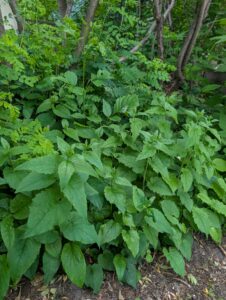
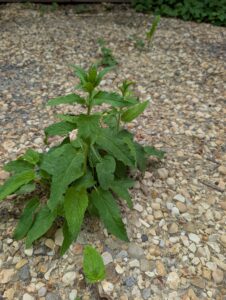
Creeping bellflower found within Garneau in Edmonton, growing near trees and through a gravel parking pad.
Creeping bellflower is still a problem despite deregulation
The Alberta Weed Control Act includes noxious weeds, which are plants that must be prevented from spreading further. Prohibited noxious weeds are plants which are rare or not yet established in Alberta and must be completely removed. One of the recent changes to the Alberta Weed Control Act is the removal of creeping bellflower (Campanula rapunculoides) from the previous designation of noxious, to not regulated and listed as a nuisance. The removal of creeping bellflower from provincial legislation does not reflect a reduction in its invasive potential; the regulatory change from noxious to nuisance is due to its widespread establishment. In many areas, including gardens, creeping bellflower continues to outcompete desired plants, persists for years despite management efforts, and creeps from backyards to front yards and into neighbours’ yards. Creeping bellflower can spread through seeds, and its extensive network of rhizomes, and small fragments left behind during removal can produce new plants, making established infestations difficult to eradicate. Read more about creeping bellflower and how to control it here
Ornamental plants as invasive species
Many of Alberta’s invasive plants were originally introduced as ornamental garden plants. They were planted because of their tolerance of poor soils, adaptability to a wide range of environmental conditions, rapid growth, especially early in the growing season, and resistance to pests and diseases. Unfortunately, those same qualities can make them excellent invaders once they escape the garden. Other characteristics, such as the plant’s ability to reproduce through large quantities of seeds or vegetative reproduction such as rhizomes, stolons, or other parts of the plant, also increase a plant’s invasive tendencies. Once invasive species are established, they can spread through seeds, rhizomes, be dispersed by birds or other wildlife, or have adaptations which assist in spread through waterways.
Although the horticultural plants highlighted below are not currently regulated under Alberta’s Weed Control Act, they are already spreading into natural areas or are at risk of becoming invasive, particularly to Alberta’s natural areas. The Canadian Food Inspection Agency has designated the ornamental and horticultural industry to be the primary pathway for the introduction of non-native invasive plants. Responsible plant selection is one of the most effective ways to prevent future invasive plant problems, as prevention of establishment is more manageable and less costly than attempting control after establishment. Certain ornamental plants may require monitoring for unintended spread, and selection of alternative non-invasive plants, especially near natural areas, is recommended.
Non-regulated plants which may become invasive if escaped
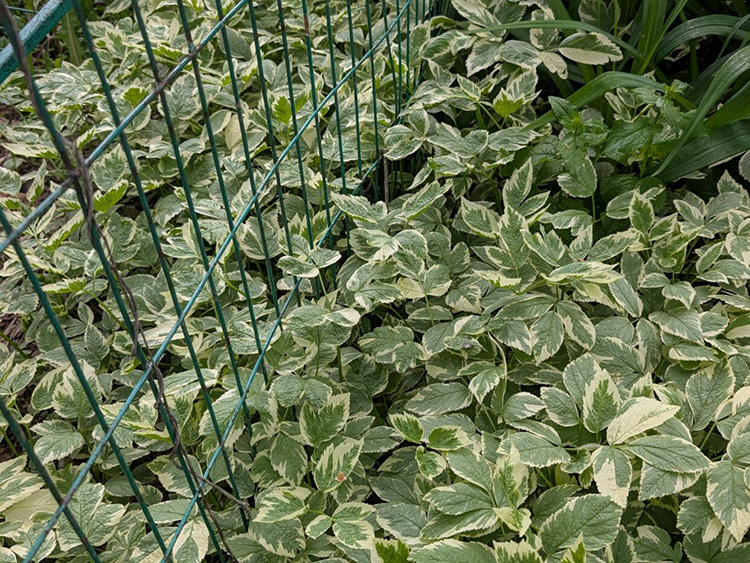
Goutweed (Aegopodium podagraria), also called ground elder, bishop’s goutweed, English masterwort, aise-weed, dog elder, and snow-on-the-mountain was introduced to North America as an ornamental plant in the early 1800s. Goutweed varieties include non-variegated (solid green leaves) and variegated (white/cream-coloured margins), which may revert back to solid green leaves. Goutweed can thrive in a variety of habitats including shaded areas and poor soil conditions, and escaped plants can be found along trails and tree lines. It produces leaves sooner than many native species, which gives it a competitive advantage in early season. Goutweed spreads through rhizomes, which are easily broken and can create a new plant from the fragmented pieces, and its rhizomes can spread as far as 70 cm per year. Goutweed can take multiple years to eradicate from an area; therefore, prevention is the most practical defence against goutweed establishment, especially near natural areas where it can invade closed canopy forests and reduce native biodiversity.
Cotoneasters (Cotoneaster spp.) are large perennial, woody shrubs which are native to Europe, western Asia, and Siberia, and were introduced as ornamentals in the mid- to late 1800s. The cultivar ‘Centennial’ cotoneaster (Cotoneaster integerrimus Medik), originated in 1957 as seed from the United States Department of Agriculture at the Agricultural Experiment Station in Cheyenne, Wyoming. Centennial is less susceptible to the bacterial disease fireblight, which is fatal to Peking and hedge cotoneaster, and affects many species in the rose family. The patch size of cotoneaster can expand when its branches encounter the soil and create adventitious roots, which expand patch size, and its extensive shallow root system facilitates spread, making established plants difficult to remove. Birds readily consume berries, which can facilitate their dispersal. According to the Invasive Species in Garry Oak and Associated Ecosystems in British Columbia, some species of cotoneasters have become established in natural areas of BC; therefore, cotoneasters should be removed when found in natural areas and should not be planted close to natural areas.
Russian olive (Elaeagnus angustifolia L.) is a tree or large multi-stemmed shrub which is native to southern Europe and central and eastern Asia. It was introduced to Canada as an ornamental, shade-producing, and windbreak plant in the early 1900s. Over a million Russian olives were planted across the Canadian prairies from 1948 to 2002 as part of the Government of Canada’s Prairie Shelterbelt Program, which was discontinued in 2013. Researchers at the University of British Columbia reviewed the invasion potential of Russian olive in North America and found that although Russian olive has been previously valued as a shelterbelt species because it tolerates colder climates and a wide range of soil conditions, it has now become invasive in Canada, especially in riparian areas. Within the United States, this species has been declared noxious in Colorado and New Mexico, and banned in Connecticut. However, Russian olive is still sold as an ornamental in Canada. The fruit is dispersed by birds, mammals, and through waterways. Russian olive can dramatically affect riparian areas as it can tolerate high shade, and ecologists have discovered that Russian olive can form a symbiotic relationship with nitrogen-fixing bacteria, as well as associations with vesicular-arbuscular mycorrhizae. These traits give Russian olive a competitive advantage and the ability to establish on poor soils. In invaded areas, Russian olive is difficult to control as its removal increases erosion by causing severe soil disturbances. Russian olive is still a popular ornamental and remains available for purchase, although it has invaded areas around Medicine Hat.
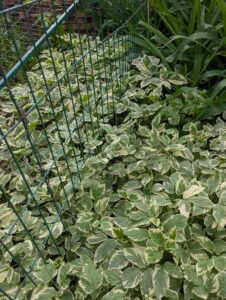
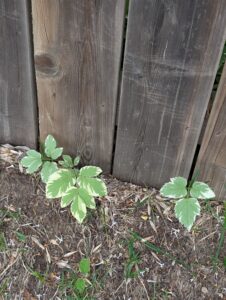
Variegated goutweed was found escaping initial planted areas.
Ornamental invasives in the garden
One of the goals of the Global Biodiversity Framework is to reduce the introduction and establishment of invasive species in Canada by at least 50 percent by 2030. Policies and regulations are only one part of invasive species management. For many ornamental plants that are not regulated, gardeners become the first and most important line of defence. With responsible plant selection, proper disposal of garden waste, careful movement of soil and plant material, and monitoring of potentially invasive plants, gardeners can make a meaningful impact on protecting Alberta’s natural areas.
Learning to identify regulated weeds, reporting prohibited and noxious species and being aware of emerging invasive plants in local areas are important steps that protect Alberta’s natural landscape. Gardeners can also share their knowledge by informing neighbours, friends, and fellow gardeners. As information found in magazines, websites, and social media may come from regions with different invasive species concerns, it is important to consult local and provincial resources to stay informed. Through combining prevention, awareness, and stewardship, gardeners can play an important role in continuing to create vibrant, resilient, and ecologically responsible gardens for future generations.