
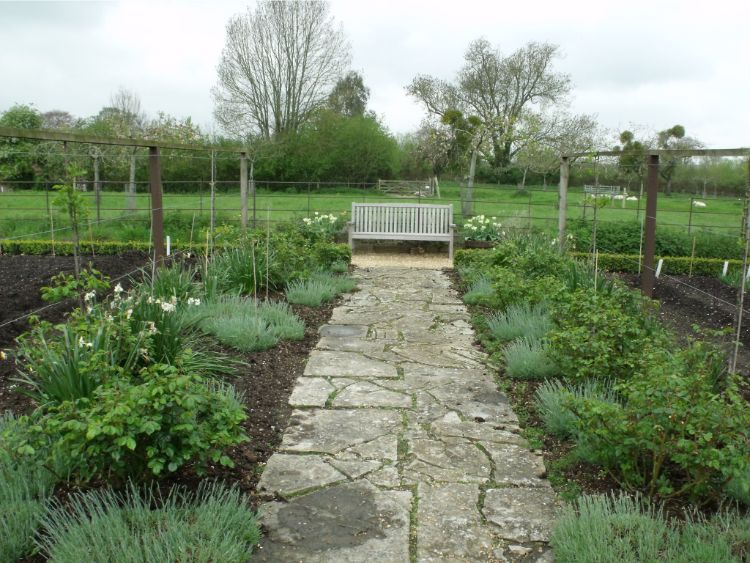
“Tintinhull Garden – The Kitchen Garden – path” by ell brown is licensed under CC BY 2.0.
Planning a Perfect Potager for Edmonton
Are you looking for a garden that combines strong form and function? Do you want to plant more vegetables in your garden? Looking to tear up that front lawn and plant species that support pollinators, but don’t want things to be too chaotic? Well then, a potager-style garden might be just for you! A potager merges food, flower, and/or herb production with a strong form that guarantees year-round aesthetics.
The History of the Potager Garden
Simply put, potager is French for soup. A potager is a French-style garden that focuses on a blend of beauty and productivity. Figure 1 gives an example. Traditionally, this type of garden is grown by mixing vegetables, herbs, and flowers in a raised bed. It relies on structural elements such as fences, arbors, obelisks, trellises and even seating to provide a form for the garden.
A potager is a functional garden with flowers, vegetables, and fruits. It is designed with colour, line, texture, rhythm, and often has a central focal point to tie it all together. The focal point can be anything you like as long as it stands out. It could be a large flowering rose vine on an arch, , a fountain, or even a sundial. Rhythm is maintained by repeating certain plants and hardscape elements. Planting herbs and vegetables in a rhythm can also make companion planting easy and help deter pests by confusing them.
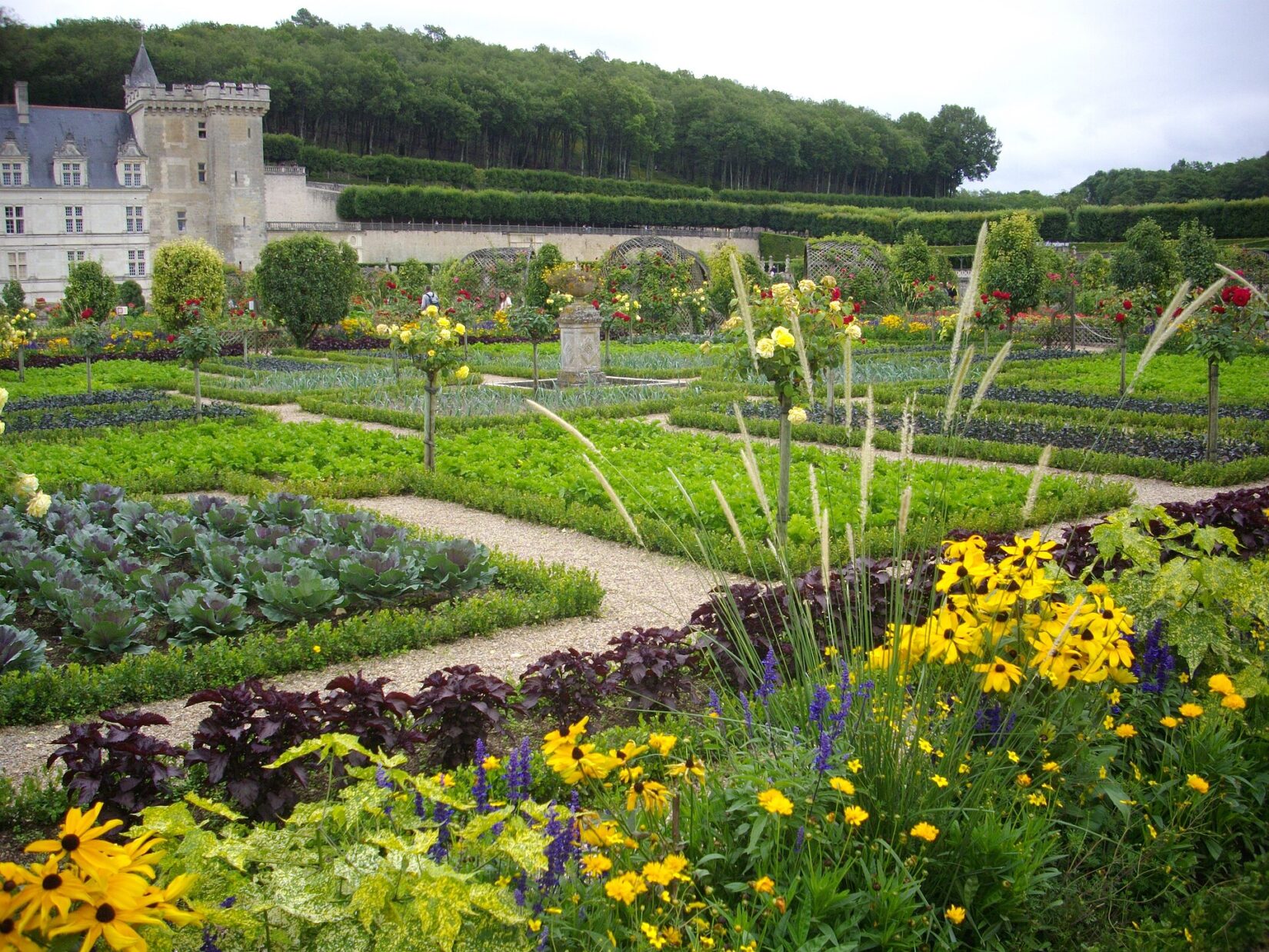
Figure 1: “File:Villandry – château, potager (03).jpg” by Fab5669
Villandry is an example of the potager recreated along with grand fountains and architecture. Potager gardens had both a practical use and were also used as a religious symbol of the monks in monasteries. These gardens provided sustenance and pleased the eye. Annual flowers, medicinal perennials, fruits, and vegetables in limited space provided maximum use of the garden space.
The Potager du Roi (King’s Kitchen Garden) is a famous potager near the Palace of Versailles, dedicated to Louis XIV. It covers nearly 25 acres, and had 30 experienced gardeners caring for over 12,000 trees in 12 production areas. Incredible! While you might not have space for a potager that size, luckily for us city-folks, the potager feel can be achieved at nearly any scale.
Potager Garden Layout Design
Let your imagination fly for this one! There is no set rule for the shape of a potager garden. It can be round, square, rectangular, zig-zag, or in the form of a cross. These geometric shapes help create a sense of order to the garden, even when the plants are a little unruly. The built structures or bed shapes often hold the pattern together all on their own. This ensures that the design is strong in all seasons and can offset the chaos of some of the less structured plants it contains.
Essential Elements in a Potager Garden
Here are the essential parts that define a potager garden. Keep these in mind when designing your garden in this style.
Line
- Strong lines and hard divisions like pathways and raised bed edges
- Built structures can add this effect year round
- Edges and lines can also be defined by plants themselves like rows of lettuce or onions.
Shape
- Generally more formal, makes use of height
- Geometric patterns, such as a square, circle, cross, and rectangle can be added along with plants
- Symmetrical plantings
- Contrasting short and tall elements
- Usually in raised beds to have permanent shape
Repetition/Rhythm
- Repeating bed shapes or vertical elements help add a formal touch. This can also help confuse harmful insects that destroy crops.
Using Colour and Texture
There are no set colour palettes or textures in a potager but you can use this design concept to really kick things up a notch. Colours that contrast with your built elements will make your hardscape elements and focal points stand out more.
Creating patterns with colour and texture, like having green and red cabbages in a checkerboard pattern, can also enhance the formal effect.
Companion planting helps create contrast as well. Parsley, onions, and carrots can be paired with nasturtiums, marigolds or calendula.
Texture tip: Try to alternate textures to get a dramatic effect that enhances the form of your potager. One example is pairing kale with chives or carrot to contrast the rough and smooth textures
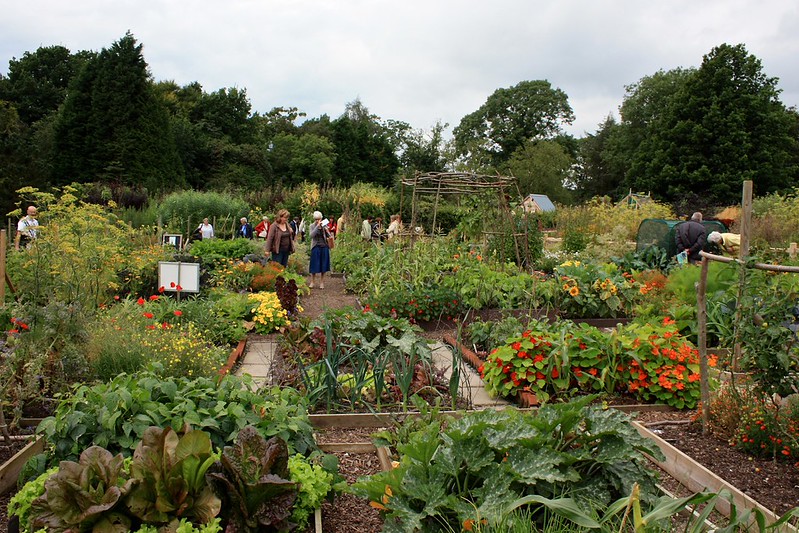
“Kitchen garden” by Neil T is licensed under CC BY-SA 2.0.
Choosing Plants for Your Edmonton Potager Garden
Edmonton is in Zone 3/4a, which means it has long harsh winters and a short growing season. Early season vegetables that can be planted as soon as snow melts include radish, green onion, spinach, peas and kale. They have a shorter growing season and can be harvested in 3-4 weeks.
After growing these early harvestable plants, you can grow your regular crop of squash or tomatoes. Potager gardens work well with square foot gardening and relay cropping to get more out of small spaces.
Classic perennial herbs like lavender and thyme work well in ground level plantings. Dwarf Russian sage or Artemisia could be used as hardier replacements for lavender.
Annual herbs are a staple of the potager as well. Basil loves the warm soil in raised beds!
Perennial wildflowers like gaillardia, tall lungwort, native beebalm, or prairie smoke can be planted for pops of colour to add interest and textured bits along edges, while also providing for our native pollinators.
Green peas are another plant that can be sown as the temperature gets above 4℃. Add peas to trellis for serving as a focal point and ease of picking pea pods. Being a legume, it naturally fixes nitrogen as well.
We hope you enjoyed reading this as much as we loved writing it. Happy gardening!