
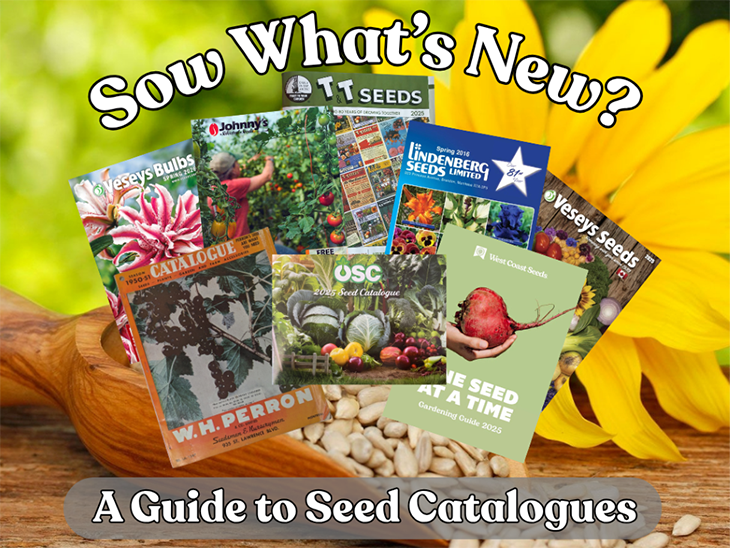
Sow What’s New? A Guide to Seed Catalogues
by Brett Kerley
Every year, I get the same handful of questions:
Where do you get your seeds? When should I start ordering? What makes one seed company better than another? And what the heck does hybrid, organic, or multi-pelleted even mean?
The truth is, gardening is one part growing and one part decoding. Before your tomatoes start fruiting or your lettuce begins to bolt, you’ll want to get comfy with the language of seeds. Understanding what you’re planting is just as important as where you’re planting it.
Let’s break it all down and give those seed catalogues the warm welcome they deserve.
Timing is Everything
Different seed companies release their catalogues at different times. Some show up like punctual old friends in December or January, while others arrive fashionably late—sometimes just before planting time. That’s unfortunate, because the earlier you order, the better chance you have of getting your favourites before they’re sold out.
My own tradition? Curling up on the couch, surrounded by catalogues and a highlighter, circling everything that catches my fancy. Prices can vary widely, but I don’t always go for the cheapest. I’ve found my go-to companies over the years—ones that treat me right, especially when things don’t go quite to plan (shoutout to West Coast Seeds—always stellar service!).
Shop Local When You Can
 While plenty of seed catalogues come from across Canada and even the US, I try to buy local when possible. Not all local companies print catalogues, but many have websites, market booths, attend Seedy Saturday or Sunday events, or supply local greenhouses. Buying local increases the chances that your seeds are adapted to our climate and will germinate more reliably here in Alberta.
That said, some of the bigger seed companies like Johnny’s Seeds (out of Maine) do offer the newest and flashiest hybrids—often trialed for better flavour, colour, or uniformity. Just keep in mind: not all of those varieties are tested for our shorter Alberta growing season. When ordering from away, look for early-maturing or short-season types.
Let’s Talk Terminology!
 Embarking on gardening as a hobby is exciting—until you’re staring at a catalogue wondering what “F1” or “open-pollinated” really means. Seed lingo can feel like a different language, so here’s a friendly translation guide to help you grow with confidence:
Landrace Seeds
A term not often seen in catalogues, but an important one to know.
Landrace varieties are locally adapted, genetically diverse seeds that have evolved naturally in a region over time. These are often stewarded by communities for generations and are incredibly resilient—making them a vital part of global seed security. Projects like the Svalbard Global Seed Vault in Norway work to preserve landrace seeds in case of natural disasters, war, or seed bank failures. These seeds are kind of like the heritage keepers of the plant world.
Heirloom Seeds
Heirlooms are the vintage treasures of the seed world—open-pollinated varieties passed down over decades, sometimes centuries. Gardeners and farmers have saved them for flavour, uniqueness, and tradition. With heirlooms, you can collect seeds at the end of the season and expect the same plant to grow again next year.
They often have quirky shapes, vibrant colours, and fascinating backstories from around the globe. You’ll never get bored exploring heirlooms—they’re full of surprises. Just keep in mind they can sometimes produce smaller yields or be more prone to disease than modern hybrids.
Open-Pollinated Seeds
These seeds are the result of natural pollination—by bees, wind, birds, or other critters. The best part? They stay true to type when you save them, meaning the offspring will look and grow like the parent plant.
Open-pollinated varieties are also genetically diverse, which can lead to some variation in size and shape—but that’s all part of the fun. If you’re into seed saving or breeding your own plants, open-pollinated is the way to go.
Hybrid Seeds
A hybrid (often labelled F1) is the result of crossing two different parent plants to get desirable traits like improved vigour, better yield, or disease resistance. These are not genetically modified organisms (GMOs)—they’re the result of good ol’ fashioned plant matchmaking.
The downside? You usually can’t save the seeds. Or rather, you can, but what grows next might not be anything like what you had. Hybrids can also sometimes sacrifice flavour for uniformity or storage life, especially in commercial varieties.
You might also see F2 and F3, which are second- and third-generation plants from that original hybrid cross. Over time, consistent traits can be selected and stabilized, eventually creating a new heirloom!
Organic Seeds
Organic seeds are produced without synthetic fertilizers or pesticides. These seeds are grown with sustainability in mind and are a great choice for eco-conscious gardeners. They often cost more, but you’re supporting better practices for both the planet and your plate.
GMO Seeds
GMO (Genetically Modified Organism) or GE (Genetically Engineered) seeds involve altering a plant’s genetic code in a lab, often by inserting genes from another species. These are rarely available to home gardeners and are mostly used in industrial agriculture. For most of us, the seeds we buy are non-GMO by default.
Pelleted & Multi-Pelleted Seeds
Some seeds—especially teeny tiny ones like lettuce or carrots—come pelleted, coated in a clay-like substance to make them easier to handle. Great for even spacing and better germination, especially if your fingers are more shovel than surgeon.
Multi-pelleted seeds are clusters—more than one seed per pellet. They’re handy if you’re planting clusters of things like onions or beets.
Determinate vs. Indeterminate Growth
 A little bonus terminology, especially helpful when you’re growing tomatoes:
- Determinate plants stop growing once they start flowering. They’re compact, tidy, and tend to fruit all at once—perfect for preserving or small spaces.
- Indeterminate plants just keep on growing. They’ll flower and fruit continually all season long and can become wild, sprawling giants. If you’re growing these, have your trellis or tomato cages ready!
Seed Catalogues Directory
Below, I have put together a list of seed companies that may be of interest to you. Go online and order from some or all of them, but I’d also recommend buying local if at all possible.
Local (Alberta)
- A’Bunadh Seeds – www.abunadhseeds.ca
- ALCLA Native Plants –https://alclanativeplants.com/
- Beautiful Blooms – www.beautifulblooms.ab.ca
- Broadview Farm – Roy Beck – www.broadviewfarm.weebly.com (at farmers markets)
- Casey’s Heirloom Tomatoes – www.caseysheirloomtomatoes.ca/
- Circle Farms Heirloom Seeds – www.circlefarms.ca
- CoCreative Seeds – www.cocreativeseeds.com
- Common Sense Seeds – www.commonsenseseeds.ca/
- Eagle Creek Seed Potatoes – www.seedpotatoes.ca
- Grower’s Blend – www.growersblend.ca
- Heirloom Seed Vault – www.heirloomseedvault.com/
- K3 Seeds – www.k3seeds.com/
- Little Beau Seed Co
- Moonglow Garden Seeds – growersblend.ca
- Prairie Hardy Nursery – www.prairiehardynursery.ca/
- Tree Time – www.treetime.ca
- Wild Rose Heritage Seed – wildroseheritageseed.com/

Canadian (unless stated otherwise)
- Annapolis Seeds
- Blazing Star Wildflower Seed Company
- Brother Nature Organic Seeds – www.brothernature.ca
- Ecoseedbank – www.ecoseedbank.com
- Halifax Seed Company Inc. – www.halifaxseed.ca
- Heritage Harvest Seeds – www.heritageharvestseed.com/
- Johnny’s Selected Seeds (US)- www.johnnyseeds.com/
- Lindenberg Seeds Ltd. – www.lindenbergseeds.ca
- McKenzie Seeds – https://mckenzieseeds.com/
- OSC Seeds (Ontario Seed Company) – www.oscseeds.com
- Prairie Garden Seeds – www.prairieoriginals.com/
- Revival Seeds
- Richters Herbs – www.richters.com
- Salt Spring Seeds
- Stokes Seeds Ltd – www.stokeseeds.com
- T & T Seeds Ltd. – www.ttseeds.com
- The Seed Company by E.W. Gaze – www.theseedcompany.ca
- Van Noort Bulb – www.vannoortbulb.com/
- Vesey’s Seeds Ltd. – www.veseys.com
- W.H. Perron – www.dominion-seed-house.com
- West Coast Seeds Ltd. – www.westcoastseeds.com
- William Dam Seeds – www.damseeds.com
- Zappa Seeds – www.zappaseeds.com/
Final Thoughts: Your Garden Starts With A Page Turn
Seed catalogues are more than lists—they’re daydreams in print. Full of possibilities, varieties you’ve never tried, and names that sound like characters in a garden fairytale.
So grab a pen, a warm drink, and settle in. Take your time. Learn the language. Your best gardening year yet could begin with that first circled seed.
May your carrots be crunchy, your peas pop with pride, and your seed orders arrive before the snow’s fully dried.
Until Then—Happy Highlighting!